Only 1 in 500 Visitors Is an AI Agent (So Far)
Categories: analytics
Our new bot & agent detection service Telltale Bot has been running for about two months now! So far we’ve seen over 100M reports from hundreds of different domains.
Perhaps the biggest finding so far is how little agentic traffic there is. Maybe this is a weird headline from a service that sells agentic detection (we also detect bots!), but so far we have seen under 1% of traffic as agentic.
Here’s what we’ve seen:
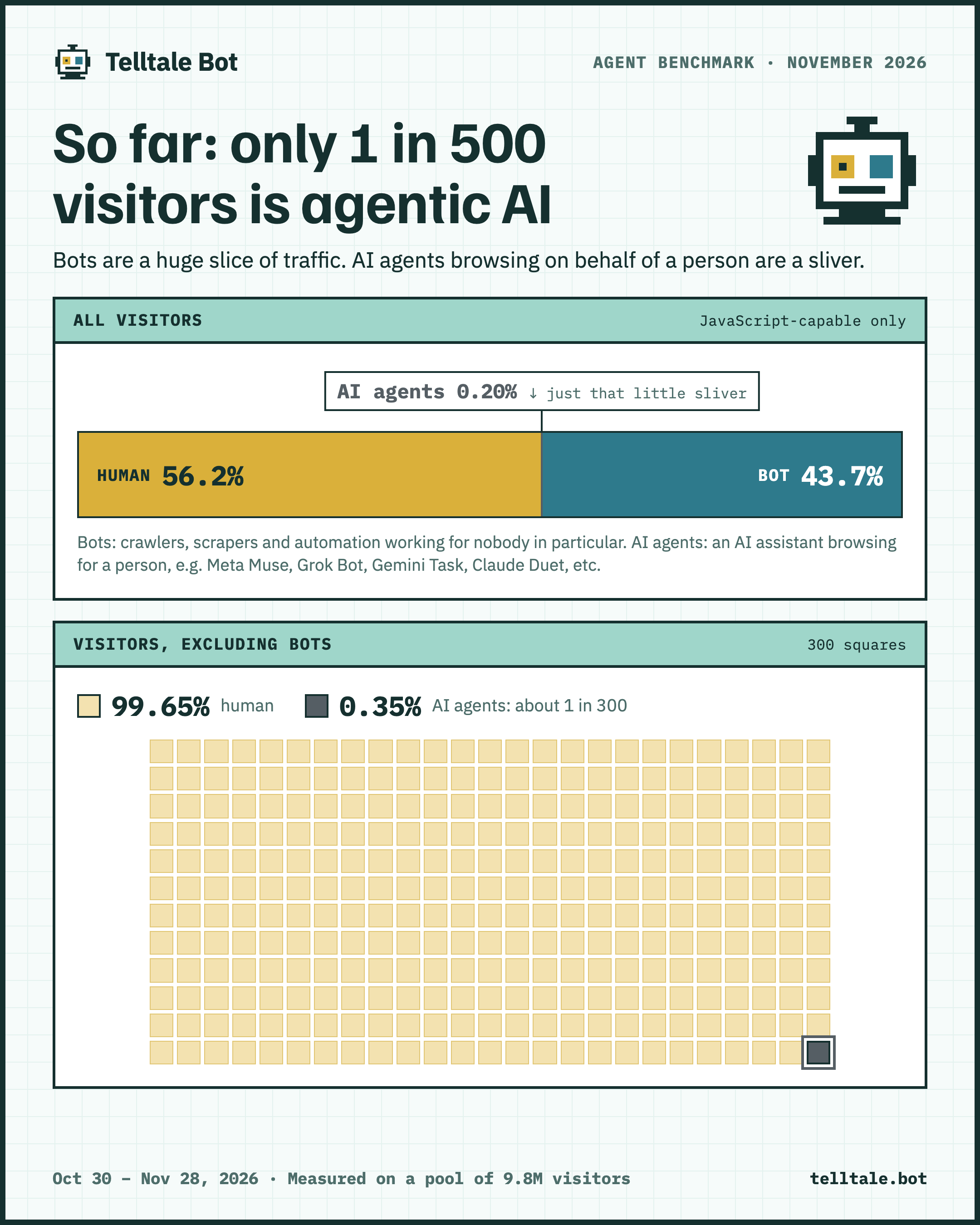
That’s your headline right there: 0.2% of visitors found to be agentic. If you drop out the bots then that share rises quite a bit to .35% (since bots are 44% of traffic), but it’s still under 1%…meaning about 1 in 300 non-bot visitors are agents.
What do we mean by “agentic”? We mean traffic from one of the AI assistants that actually browse and can act on a site on your behalf. Meta Muse, Claude Duet, OpenAI Dots, Grok Bot, Gemini Task, etc. These tools have gotten a huge amount of hype considering the low level of traffic they have produced so far. Their traffic is, for now, a tiny sliver of the pie.
Should we care about 1 in 300 human-like visitors? If we were talking about browsers, that would be like spending a lot of time thinking about just the users of mobile Opera… which very few analysts would bother with.
One reason to care is agentic traffic’s growth curve. This type of traffic is only a few months old, and already it is driving a measurable amount of traffic. Microsoft Clarity did an agentic traffic study that shows 88% growth in that kind of traffic over just 3 weeks. Will that growth continue to rocket up and be 5% of traffic in a few more months? Or is this more like the guy that plotted his newborn baby’s growth rate curve after a couple months and projected his baby will be 17 feet tall by the time he’s 3 years old? Nobody knows (about the agentic stuff, not the 17′ tall toddler). The makers of these agents would like us all to believe this is a foregone conclusion: that we all will outsource our lives to Dots/Grok/Duet/etc, but I am skeptical and you should be too.
Despite legitimate skepticism, another reason to care is that this agentic traffic represents the tip of the iceberg on “AI traffic” more generally. While most of us aren’t ready to take a picture of our credit card and give it to Grok Bot to go buy stuff for us (really Elon??), there are plenty of people using AI to do product comparison and background research. That part of the equation happens from the AI’s own training data, internal search, open web search, cache, and JavaScript-less web fetch.
By our definition “agentic traffic”, is when AI assistants are using a real web browser with JavaScript capabilities… and that’s what Telltale Bot detects.
Even if it’s only 0.2%, it’s a segment that’s worth keeping an eye on. While that may be not a huge concern for a lot of sites, the level of bots overall is a growing concern for sites at all levels of traffic.
Thus the second headline number here, which is that 44% of traffic was bots. Let’s dig into that, because in some ways I find that even more interesting than the agentic number.
That 44% is much lower than the oft-quoted 60%+ bot number from Cloudflare Radar. First of all, obviously Cloudflare’s sample is far far better than mine. They see something like 20% of web traffic, and I have a two-month-old service with a few dozen customers. So they are seeing a little more data than me. What our samples do have in common is that both self-select towards sites that have bot issues. In other words, you aren’t that likely to sign up for my service or place your site behind the Cloudflare proxy unless you think you have a bot issue. Secondly, my 44% is from JavaScript-capable browsers, and their 60%+ is from all HTML fetches. If we look on Cloudflare for just calls to JSON content, we see 39% bot which is a lot closer to our number.
Bottom line:
If we’re measuring ALL traffic to webpages (smart/JavaScript capable + dumb/non-JS) then we’re talking 60% bots.
If we’re measuring smart traffic to webpages (just clients that execute JavaScript or call JSON) then about 40% bot.
The “real” numbers are likely a little bit lower due to the sample bias I mention. Additionally, when Cloudflare measures calls to JSON that could include dumb bots that just happen to be pointed at JSON files. I could continue to just drop more caveats, but nobody wants to read that.
Ok yea, but is it really only .2%??
To my knowledge, nobody else has yet reported this kind of overall traffic share percentage. In an attempt to prove to you (and myself) that I haven’t run off the edge of the canyon with nothing underneath me, Wile E. Coyote-style, let’s look at some other sources. Aside from Telltale Bot (obviously), one of the best sources of AI and agentic info is Microsoft Clarity. I mentioned earlier Clarity’s analysis of what AI agents do on websites. There’s two interesting findings in that Clarity article for us here:
1) Agentic sessions *did stuff*. This goes back to our question about why we should care about this traffic even if it’s only .2%. Clarity reported that 25% of agentic sessions hit checkout and 20% submitted a form. This fits with how we should expect agentic traffic to work, it’s on your site because it was directed by a human to do a task on their behalf.
2) There was huge growth in agentic volume (88% in just a few weeks), but the overall percentage can be inferred to have been very low. Yes, Clarity examined 5.2M sessions, but they do so across 230,511 projects. That works out to 23 agentic sessions per project, or less than one agentic session per day per project.
Clarity runs on millions of sites, and we don’t know how they picked the 231k they ran their test on. Still, we can guess they picked sites that had decent amounts of traffic to generate a solid sample of agentic use and smart events for their analysis. If the average number of monthly sessions per site in that sample was 50K, that works out to only .05% agentic sessions. If the average was 10K, then .25%. We have no way of knowing what the average number was, but most reasonable volume guesses put Clarity’s number even lower than our 0.2-0.4% range.
This makes sense, as we should expect Clarity’s agentic traffic share to be lower than ours. Clarity’s data sample ended Sep 9, and ours ended Nov 28. Clarity only detected ChatGPT, Gemini, and Claude. Telltale Bot also identifies Muse, Grok Bot, Perplexity, Instinct, and a few others.
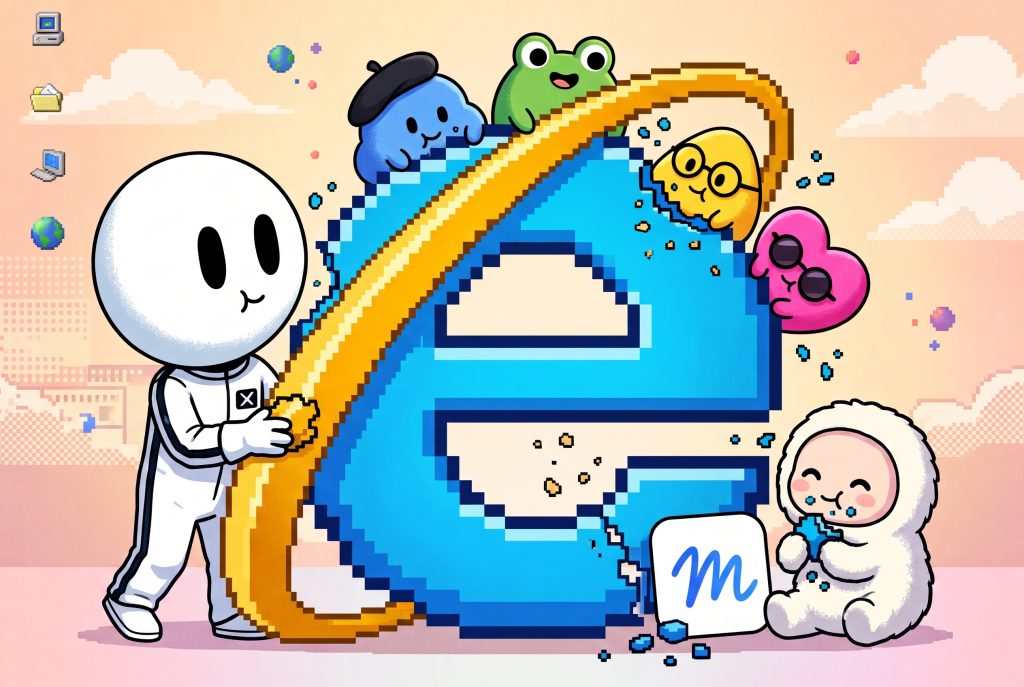
In the first version of this image the Meta Muse labubu thing was eating its own logo. Seems about right.
What this means for your site
Whatever the average level is, your site likely isn’t at that exact percentage for either bots or agents! This is because the variation of bot and agent level differs greatly per site. There was a 40x spread in agentic share between the lowest site and the highest, and bot percentages varied greatly as well.
Some of the sites in our sample have really horrible bot issues. These sites are getting unprecedented waves of very sophisticated bots even behind multiple layers of bot & firewall protection. Others have only a baseline level of mostly respectful crawlers. On the agentic side, some had nearly zero agentic traffic while others had low single digit percentages.
- Look at your own traffic. Benchmarks are great but don’t tell you about your particular site.
- Watch pageviews AND visitors. While the agent levels were universally low when measured by % of visits, some of the agents have the very bot-like quality of requesting enormous amounts of pages.
- Make a plan for how you want to deal with agentic traffic. Are you going to block agents? Give them a different version of the site? Just treat them like regular human visitors? Now is the time to think about this, while the levels are still low.
Methodology Notes:
Data from Telltale Bot, between Oct 30 and Nov 28, 2026. Only pageviews where our script ran and reported are counted. Sites that opted out of published statistics and our own test traffic are excluded. Data drawn from a pool of 9.8M total visitors, subject to random sampling to avoid very large sites overweighting the results. Historical data was partially rescored with most recent detection rules to account for agents like Grok or Muse that occasionally slip detection with new builds or stealth methods. Agents injected into real browsers via extension (as opposed to standalone apps or cloud exits) are not always identified. Please see https://telltale.bot/agents.html for the most recent list of what we currently detect.
No comments yet.